
The Market Prices Pounds, The Land Prices Maintenance
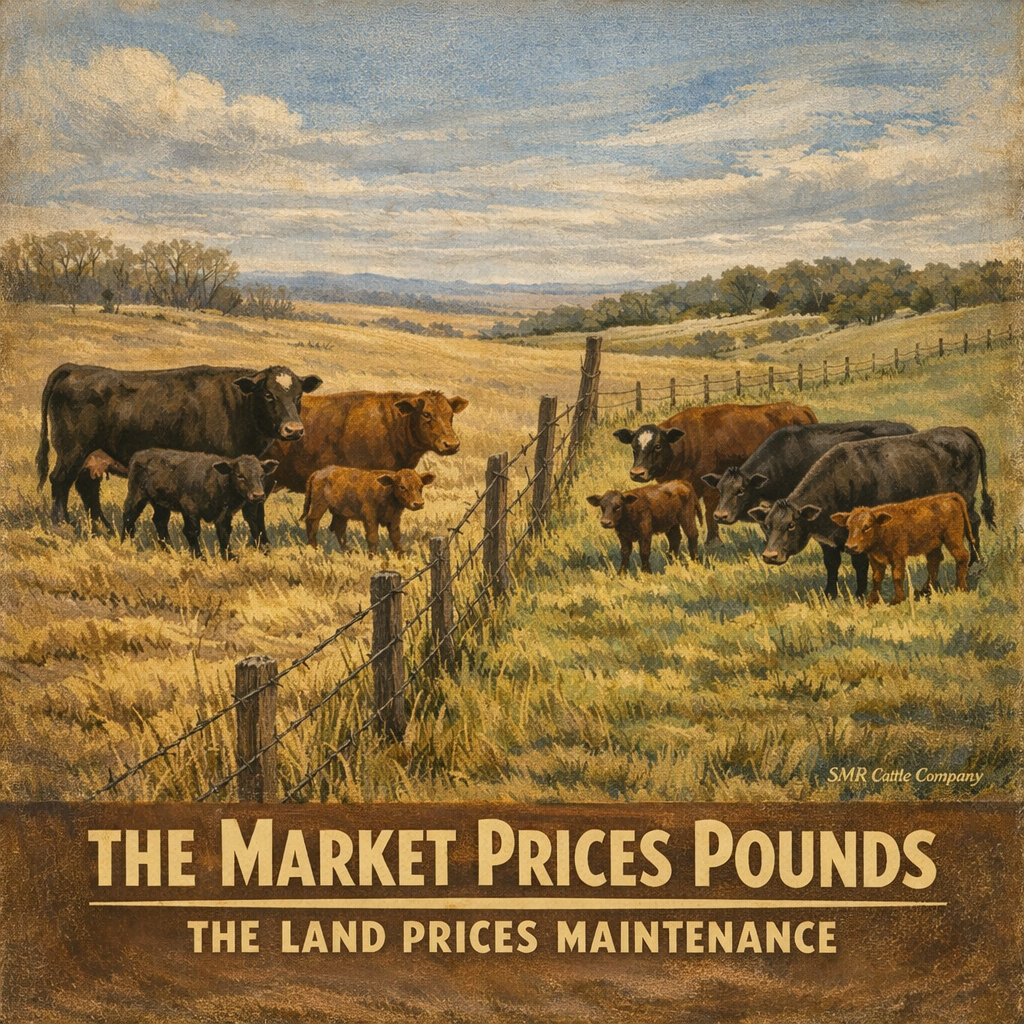
Cattle markets price by the pound.
It's the way it's always been.
Heavier calves bring more revenue.
Larger cows often wean heavier calves.
If a 650-pound calf sells for more than a 550-pound calf, the conclusion seems obvious:
Bigger is better.
On paper, size appears profitable.
But pounds are never free.
They carry a maintenance cost that is paid every single day — in feed.
Maintenance Is the First Expense
Before a cow can grow a calf, rebreed, or add a pound of gain, she must first maintain herself.
Maintenance is not optional. It is the baseline cost of being alive.
A mature cow’s nutrient requirement is driven primarily by body weight. As body weight increases, dry matter intake increases almost proportionally. A 1,500-pound cow does not eat slightly more than a 1,200-pound cow. She eats 36% more — every day of the year.
And maintenance happens 365 days a year.
Calf revenue happens once.
That distinction matters.
If a larger-framed cow consumes 36% more forage annually, she must generate enough additional revenue to offset that increased intake. Not just in a good year — every year.
Because the land is paying that feed bill first.
Stocking Density Is the Real Lever
More intake per cow means fewer cows per acre.
And stocking density is not a secondary detail in grazing systems. It is the primary economic lever.
Revenue in a forage-based system is not generated by individual cows. It is generated by acres.
Total system output equals:
(Number of cows carried per acre) × (Pounds weaned per cow)
Most producers focus on the second variable. The market rewards it visibly.
But the first variable — cows per acre — determines whether the system works.
If increasing mature size reduces stocking rate, the equation shifts. Even if individual weaning weights increase, total pounds weaned per acre may decline.
That is the tradeoff most spreadsheets do not fully capture.
Carrying Capacity Is Biological, Not Theoretical
Land has a carrying capacity determined by rainfall, soil health, forage species, and recovery time.
If larger-framed cows require more forage to maintain body condition and rebreed, the land must either:
Carry fewer females
Be supplemented with external feed
Or be stocked beyond rainfall capacity
None of those are neutral decisions.
Carrying fewer females reduces total reproductive units. That means fewer calves, fewer pounds, and less gross revenue per acre.
Supplementation introduces dependency on purchased inputs. Now profit margins depend not only on cattle prices, but also on feed markets.
Stocking beyond rainfall capacity erodes pasture health. Recovery periods shorten. Root systems weaken. Drought impact intensifies. The system becomes fragile.
In each scenario, resilience declines.
Bigger Cows Do Not Automatically Mean Greater Efficiency
A 1,500-pound cow may wean a heavier calf. She may post impressive individual performance numbers.
But efficiency in a grazing system is not measured by individual output.
It is measured by:
Pounds weaned per acre
Reproductive consistency
Input dependence
Drought survivability
If larger cows reduce total cows carried on the same land base, total pounds weaned per acre decline — even if each calf is heavier.
Individual performance is not the same as biological efficiency.
And biological efficiency is not the same as economic resilience.
Weather Variability Changes the Math
In a favorable year with abundant rainfall, the difference between cow sizes can appear marginal. Forage is plentiful. Stocking pressure feels manageable. Supplementation is minimal.
But grazing systems are not tested in favorable years.
They are tested in dry years.
During drought, maintenance demand does not shrink with forage supply. Larger cows still require the same baseline intake. When forage availability declines, larger-framed cattle create pressure faster.
Producers are forced to:
Sell deeper into the herd
Buy expensive supplemental feed
Or accept declines in body condition and reproductive performance
Over a single good year, the advantage of larger cattle may look profitable.
Across ten years of weather variability, moderate-framed, forage-adapted cattle often maintain reproductive stability with fewer external corrections.
That stability compounds.
Moderate Size Changes the Equation
Moderate-framed, forage-efficient cattle:
Reach maintenance with less intake
Allow higher stocking flexibility
Recover body condition more easily
Maintain reproduction under tighter forage conditions
Increase total production per acre within rainfall limits
They align animal demand with ecological supply.
And alignment is what builds resilience.
Because forage is not just feed. It is:
Land
Rainfall
Sunlight
Soil biology
Recovery time
When mature size outpaces carrying capacity, the system compensates through lower stocking rates or higher inputs.
Neither increases margin stability.
The Lease Is Not the Real Forage Cost
Many ranchers calculate land cost by what the lease agreement states.
For example, a lease may dictate $20 per month per cow/calf pair.
On paper, that feels clear. Sixty dollars per quarter. Two hundred forty dollars per year. Simple.
But that number only reflects the price of access to land.
It does not calculate the biological cost of forage consumption.
The real question is not what the lease costs.
The real question is: how much forage is each cow consuming — and what is that forage worth in lost opportunity?
Heavier cows eat more. Moderate cows eat less.
If you place four heavy cows in a pasture, you may have forfeited the ability to run five moderate cows on that same acreage.
Now the math shifts.
Let’s walk through it.
If four heavy cows each wean a calf that is 100 pounds heavier than a moderate cow’s calf at weaning, that equals 400 extra pounds total.
That sounds like an advantage.
But if five moderate cows could have occupied that same pasture, you are potentially raising an additional calf. That fifth calf may add 550 pounds on its own.
Even conservatively, that is 150–200 more pounds raised per acre than the heavy-cow scenario.
And that does not even evaluate the cost of getting those calves on the ground.
Heavier cows consume significantly more forage per year than moderate cows. That increased intake further reduces the true value of those extra 400 pounds.
A 1,500‑pound cow costs approximately $677 per year in hay and forage. An 1,100‑pound cow costs approximately $529 per year in hay and forage.
That difference does not include additional supplementation often required to maintain larger cows through tighter forage conditions.
Now let’s apply calf prices.
Assume calves are selling at $3 per pound — and this does not even account for the likely price slide that occurs as calf weights increase.
A 1,500‑pound cow weaning a 650‑pound calf grosses $1,950. An 1,100‑pound cow weaning a 550‑pound calf grosses $1,650.
On the sale receipt alone, that appears to be a $300 advantage for the heavier cow.
Now subtract annual forage cost.
$1,950 minus $677 equals $1,273. $1,650 minus $529 equals $1,121.
On paper, the heavy cow still appears to maintain a $152 advantage.
But that comparison ignores stocking rate.
If removing four heavy cows allows five moderate cows to be stocked, the numbers change entirely.
Five moderate cows cost $2,645 annually in forage (5 × $529). Five 550‑pound calves gross $8,250. Subtract forage cost and you are left with $5,605.
Now compare that to four heavy cows.
Four 650‑pound calves gross $7,800. Four heavy cows cost $2,708 annually in forage (4 × $677). That leaves $5,092.
Now the moderate cows hold a $513 advantage on the same acreage.
Scale that to a herd of 100 heavy cows. The potential deficit becomes $12,825.
Trade 100 heavy cows for 100 moderate cows and the land may support an additional 25 moderate cows. That additional production is what captures that lost $12,825 — and potentially more.
Yes, there are other variables. More cows can mean more labor. More calving events. More management decisions.
But those challenges can be mitigated through genetic selection for calving ease, structural soundness, and maternal efficiency.
There is always a loophole. There is always a solution.
But when every variable is followed to its conclusion, one pattern continues to surface:
Moderate cows increase the margin.
It takes time, capital, and disciplined thinking to change a system. It is similar to starting any business — the transition requires intention.
But when the choice is long‑term sustainability versus short‑term survival, the shift is worth it.
Because the lease is not the true cost.
Forage is.
And forage is priced in opportunity.
How These Numbers Were Calculated
We compared production on the same acreage.
Four 1,500-pound cows weaning 650-pound calves produce 400 extra pounds compared to four moderate cows. However, that same pasture could support five 1,100-pound cows.
At $3 per pound:
• 650-lb calf = $1,950
• 550-lb calf = $1,650
Annual feed cost from weaning to weaning was calculated using:
• Six months of winter hay at $165 per ton
• Intake at 2.5% of body weight
• Six months of grazing at $20 per month per pair
This results in approximately:
• $677 per year for a 1,500-lb cow
• $529 per year for an 1,100-lb cow
When stocking rate is applied:
Five moderate cows:
550-pound calves × $3 = $1,650 per calf
5 calves × $1,650 = $8,250 gross revenue
Annual forage cost per moderate cow = $529
5 cows × $529 = $2,645 total forage cost
$8,250 − $2,645 = $5,605 remaining after forage cost
Four heavy cows:
650-pound calves × $3 = $1,950 per calf
4 calves × $1,950 = $7,800 gross revenue
Annual forage cost per heavy cow = $677
4 cows × $677 = $2,708 total forage cost
$7,800 − $2,708 = $5,092 remaining after forage cost
$5,605 − $5,092 = $513 advantage to the moderate cows on the same acreage
All calculations assume equal reproductive rates and do not include additional supplementation, price slide on heavier calves, or drought adjustment.
The comparison isolates one variable: mature cow size — and its impact on land-level economics.
