
Is It the Cow’s Fault?
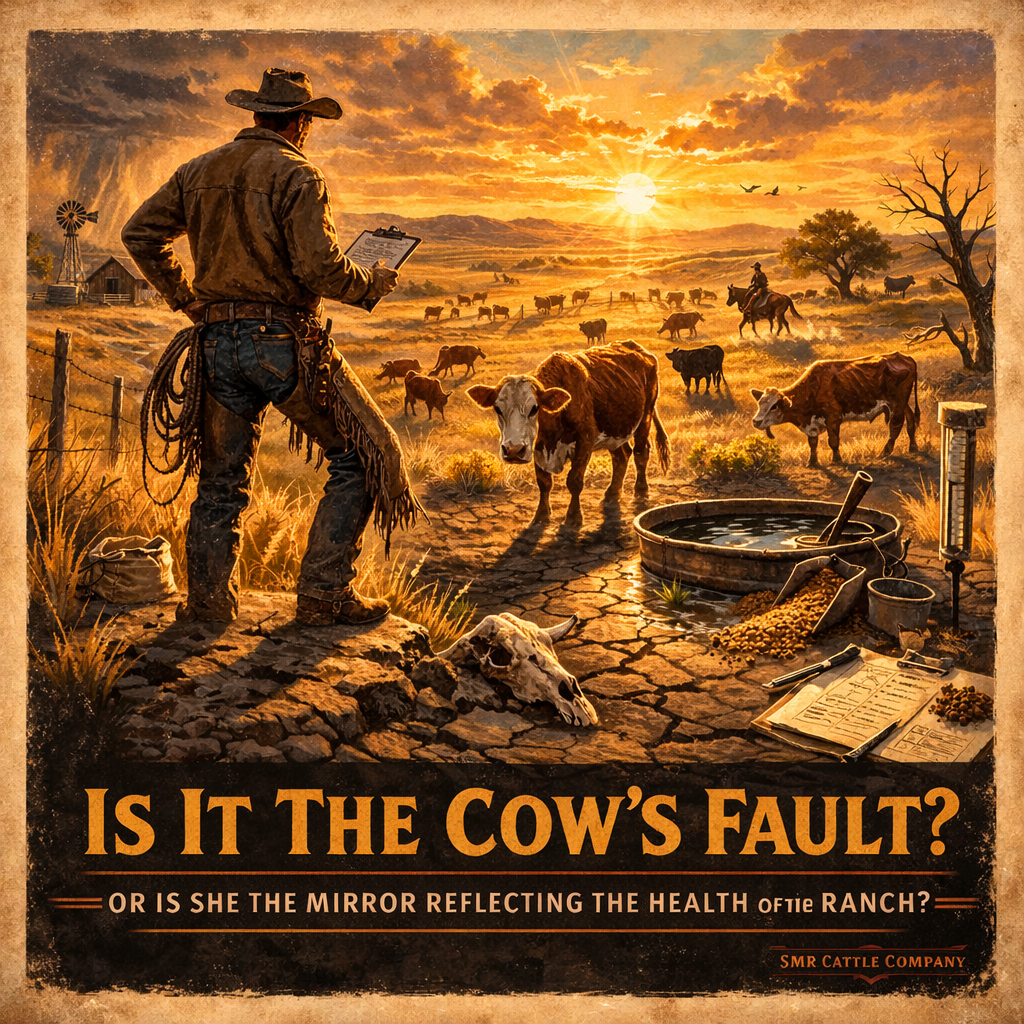
When fertility declines…
When body condition scores begin to slip…
When the calving window stretches wider each year…
When more cows show up open at preg-check…
The question often rises quickly across ranch country:
Is it the cow’s fault?
In a commercial cattle operation, culling is not an emotional exercise. It is an economic decision. And on the surface, it makes perfect sense.
The Economic Reality of Culling
A cow that fails to breed within a defined window is expensive.
An open cow has consumed a full year of forage, mineral, labor, and overhead without producing a marketable calf. In most commercial systems, that is not sustainable.
A late-calving cow is also costly. Her calf is younger at weaning, lighter at sale time, and often discounted when marketed in larger groups. Multiply that across a herd, and uniformity begins to erode. Uniformity drives truckload premiums. Truckload premiums drive profitability.
A cow that loses body condition requires intervention. That intervention might look like supplemental feed, additional hay, higher-protein inputs, or labor adjustments. All of those have a cost.
From a strictly operational standpoint, it is economically rational to remove:
Open cows
Chronic late calvers
Cows that consistently lose body condition
Structurally unsound females
Cows that fail to raise a strong calf
Ranchers are not wrong to protect margin.
Biology must convert to economics.
But that still leaves the deeper question unanswered.
Is it the cows fault?
Reproduction Is an Energy Decision
Fertility is not a switch that flips on and off.
Reproduction is an energy-dependent function. A cow will only cycle, conceive, and maintain pregnancy when her body perceives that survival and nutrient availability are adequate.
For a cow to breed back on time, she needs:
Adequate energy intake
Sufficient protein availability
Balanced mineral consumption
Manageable stress load
A fertile, active bull
Disrupt any one of those variables, and reproductive efficiency begins to decline.
Now ask a harder question:
What did the environment look like this year?
Environmental Pressures That Change the Outcome
Drought reduces forage biomass and often lowers crude protein and digestibility. Cows may appear full but are operating in an energy deficit.
Extended fall grazing can push cows onto mature, weathered forage that no longer meets maintenance requirements. If cows enter winter thin, the metabolic cost of recovery increases dramatically.
Overgrazing reduces plant recovery and total forage production the following cycle. That compounds nutritional stress during breeding season.
Mineral programs that lack placement strategy or palatability management can result in inconsistent intake. Subclinical deficiencies often show up first as reduced fertility.
Bull performance is frequently overlooked. A bull that is heat stressed, under-conditioned, overworked, or subfertile can easily extend a calving season by weeks.
Late weaning can delay postpartum recovery and shorten the window for cows to return to cyclicity before breeding.
Heat stress, parasite pressure, long travel distances to water, or poor pasture allocation can all tax the system.
When fertility declines across a meaningful percentage of the herd, it is rarely the failure of isolated individuals.
It is usually a signal.
The cow is often reflecting the conditions she was given.
The Cow as a Barometer
Body condition score decline is rarely singular.
It may indicate:
Forage allocation mismatches
Stocking rate pressure
Timing errors in pasture moves
Inadequate mineral strategy
Poor recovery between calving and breeding
When calving windows stretch year after year, the issue is not always genetic decay. It may be inadequate breeding pressure, bull-to-cow ratio imbalance, or systemic nutritional stress leading into the breeding season.
Cows do not operate independently from land.
They are biological expressions of the system.
And Yet… Selection Still Matters
Here is where the conversation becomes uncomfortable.
Even if environmental stress contributed to poor performance…
Even if drought reduced forage quality…
Even if mineral intake was inconsistent…
Each ranch still has operating norms.
Every ranch has a context:
A rainfall pattern
A forage base
Soil types and recovery rates
Labor capacity
Wintering strategy
Supplement philosophy
Marketing endpoint
A cow that thrives under irrigated, high-input conditions may fail under dryland, low-input management.
A cow that performs in mild climates may struggle in heat, wind, or long winters.
Selection is not moral.
Selection is contextual.
If a cow cannot reproduce and maintain herself within the defined management and ecological realities of a ranch, she will be culled — even if the root cause was environmental pressure.
That is not cruelty.
That is alignment.
The Critical Shift: From Blame to Context
The danger is not culling.
The danger is blaming cows without evaluating context.
If a handful of cows fail, selection pressure may be working correctly.
If a large percentage of the herd struggles, the system deserves scrutiny.
Before asking, “What’s wrong with this cow?”
Ask, “What conditions did we create?”
If those conditions remain unchanged, the next set of cows will face the same outcome.
Genetics cannot outrun environment.
But when context is clearly defined, selection becomes powerful rather than reactive.
You begin selecting for:
Fertility under your rainfall volatility
Body condition stability on your forage base
Structural integrity on your terrain
Temperament that fits your labor capacity
Efficiency without heavy supplementation
That is when herds begin to compound biological capital instead of eroding it.
It May Not Be Her Fault
But it is always the ranch’s responsibility.
Every ranch is a biological and economic system operating within environmental boundaries.
Cows that cannot function within that boundary will leave the herd — not because they are defective, but because the system requires compatibility.
The future of a ranch will not be determined by how harshly it culls.
It will be determined by how clearly it understands its context.
Know your rainfall patterns.
Know your forage recovery time.
Know your mineral gaps.
Know your stocking rate thresholds.
Know your labor realities.
Context drives selection.
Selection drives fertility.
Fertility drives economics.
Economics sustains stewardship.
The cow is not the enemy.
She is the mirror.
The real question is no longer:
Is it the cow’s fault?
The better question is:
Have we built a system where the right cows can thrive here?
