
Genetic Leverage: How Moderate Cows Paired With the Right Bulls Increase Income
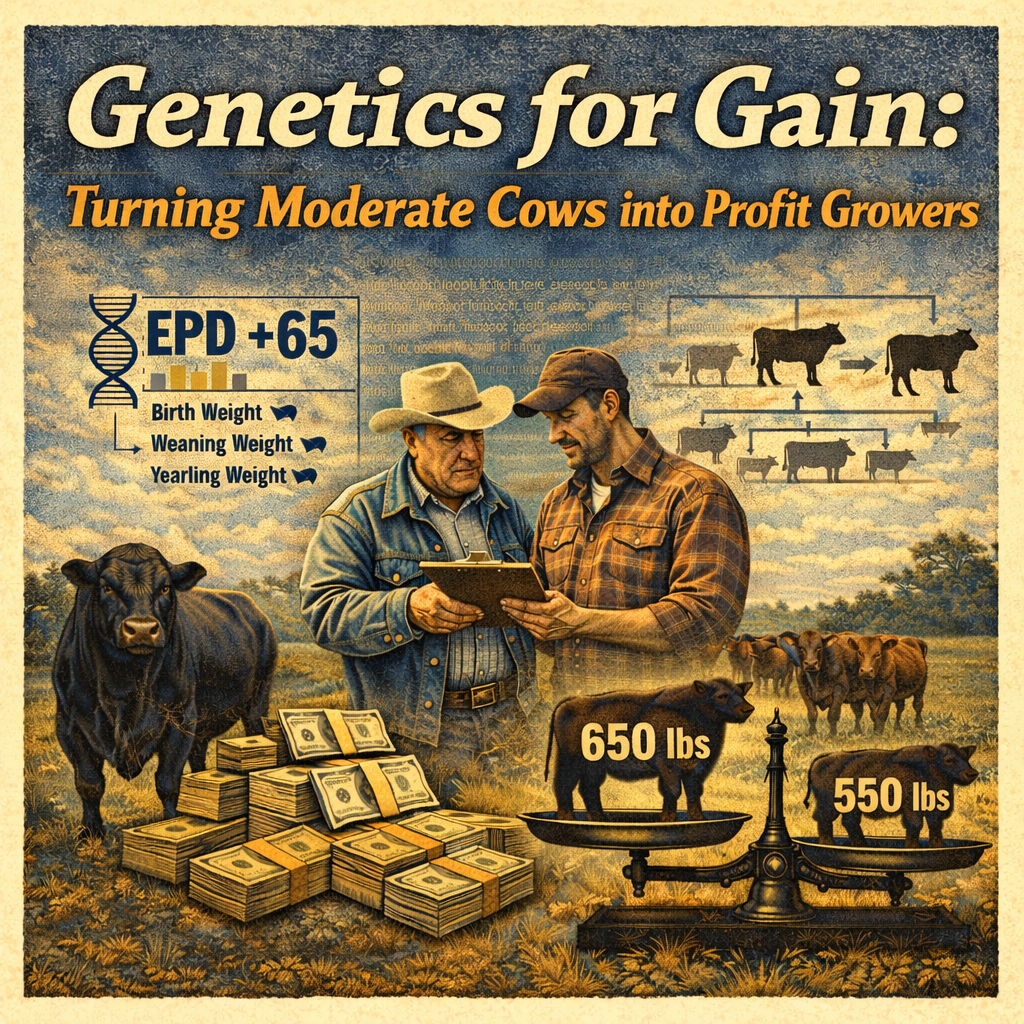
The conversation around cow size often ends at maintenance cost.
But that is only part of the equation.
If moderate-framed cows reduce forage demand and increase stocking rate, the next logical question becomes:
How do we increase weaning weights without increasing mature cow size?
Separate Maintenance From Growth
Mature cow size and calf growth potential are not the same genetic trait.
A cow’s maintenance requirement is driven primarily by her mature body weight and frame size. A calf’s weaning performance is heavily influenced by sire genetics.
Increasing cow size does not automatically increase weaning weight in a proportional or efficient way. In many cases, producers increase annual maintenance cost long before they see meaningful improvement in calf performance.
Selecting larger cows to chase heavier calves often confuses two separate biological functions.
A disciplined system separates those functions:
The cow is selected for fertility, structural integrity, longevity, and forage efficiency.
The bull is selected for growth, muscle expression, and measurable performance traits.
When those roles are intentionally divided, growth can be increased without increasing annual maintenance.
Build the Right Cow Base First
Start with the cow herd.
A moderate 1,100–1,200 pound cow that:
Breeds back every year
Holds body condition on forage
Calves unassisted
Weans a solid calf consistently
Is already working with your land, not against it.
Her maintenance cost is manageable. Her forage demand fits your carrying capacity.
But knowing only the bull’s EPDs and genomic results is not enough.
Every calf is built from two sides — the sire and the dam. If you do not know the genetic profile of your cows, you are only seeing half the picture.
Without cow EPDs and genomic data, you cant fully understand:
Their mature weight potential
Their milk levels
Their growth tendencies
Their carcass traits
Their fertility strengths or weaknesses
When that information is missing, even the best bull selection becomes less precise.
Genomic testing and EPD evaluation of the cow herd establish your starting point. They tell you what genetics already exist before you introduce new ones.
If you do not know where you are starting, you cannot reliably predict where you are going.
Using EPDs to Add Weaning Weight
When moderate cows are paired with bulls selected for measurable performance traits, we are not guessing at growth — we are using data to influence it.
Expected Progeny Differences (EPDs) are one of the primary tools available.
EPDs estimate the genetic potential a bull will pass to his calves relative to other bulls in the breed. They are comparative tools built from performance records, pedigree information, and progeny data.
For weaning weight improvement, the key trait is Weaning Weight (WW) EPD.
For example:
A bull with a +70 WW EPD is expected to sire calves that average 20 pounds heavier at weaning than a bull with a +50 WW EPD, assuming cows and environment are comparable.
Strong Yearling Weight (YW) EPDs indicate continued post-weaning growth potential.
Acceptable Birth Weight (BW) and Calving Ease (CE) EPDs allow growth to be added without increasing calving difficulty.
If a moderate cow herd averages 550‑pound calves at weaning, selecting bulls 20–40 pounds above breed average for WW EPD can realistically move that average toward 580–600 pounds over time.
That improvement is genetic — not nutritional inflation.
And it does not require feeding a 1,500‑pound cow year‑round.
EPDs Are a Tool — Not the Only Tool
It is important to be clear: EPDs are not magic.
They are a tool.
They must be interpreted alongside phenotype, structural soundness, disposition, fertility, and environmental adaptability.
But just as important as predictive tools is recorded ranch data.
If you are not collecting real birth weights, real weaning weights, and real yearling weights, you are relying solely on someone else’s numbers.
To tighten prediction into reality, operations should record:
Actual birth weights
Actual 205-day adjusted weaning weights
Feed intake and performance data if calves are retained post‑weaning
Actual yearling weights
Finished weights if cattle are carried to harvest
Those numbers bring accountability to your operating system.
They allow you to compare predicted genetic potential against real-world performance under your environment, your forage base, and your management.
EPDs point direction. Recorded ranch data confirms accuracy.
When both are used together — genomic testing on the cow herd, EPD selection on the bulls, and disciplined performance recording — genetic progress becomes measurable instead of assumed.
Growth Is Seasonal. Maintenance Is Annual.
This is the economic advantage.
Weaning weight is expressed for roughly 205 days. Maintenance cost is paid 365 days a year.
By concentrating growth genetics in the sire while maintaining moderate, forage-efficient cows — and validating progress through real performance data — producers capture additional pounds during the calf’s growth phase without increasing annual forage demand.
Instead of increasing maintenance to chase growth, growth is layered onto an already efficient cow base and measured honestly.
The Per‑Acre Impact
Let’s simplify the stocking advantage.
If your land can run 100 heavy cows, it may be able to run 125 moderate cows instead.
Now add genetics.
If bull selection increases weaning weights by just 50 pounds per calf, here is what that looks like:
125 moderate cows × 600‑pound calves = 75,000 total pounds of calf.
100 heavy cows × 650‑pound calves = 65,000 total pounds of calf.
Even though each heavy cow weans a bigger individual calf, the moderate cow system produces 10,000 more pounds overall on the same land base.
And it does that without increasing annual forage demand per cow.
That is where the income difference comes from.
Not from having the biggest cows or heaviest calves.
From running the right number of efficient cows and using genetics to increase calf growth intentionally.
Income Is Driven By Design
The market rewards pounds.
But the rancher controls how those pounds are created.
Moderate cows reduce fixed biological cost. Genomic awareness establishes a starting point. EPDs guide growth direction. Recorded ranch data validates results.
Together, they widen margin.
It is not about chasing frame size. It is about building a herd where:
Maintenance remains controlled
Fertility remains consistent
Weaning weights are intentionally increased
Genetic direction is measurable
Outcomes are recorded
And total pounds per acre rise without increasing forage pressure
Genetics are not just phenotype. They are economic architecture.
When moderate cows are paired with the right bulls — and when predictions are verified by real-world data — income increases because growth is applied precisely where it pays.
The land stays balanced. The cows stay efficient. The numbers tell the truth.
That is leverage.
